Ishan Maheshwari (b. 2002, Noida, India) is a photographer and writer based between Bristol and Delhi. His work examines how power, memory and colonial inheritance are embedded in land and institutions.
Working across documentary photography, archival research and text, he photographs in the Indian Himalayas, across North India and in Bristol, where his current projects trace the city's tobacco and slavery histories through its built environment and museum collections.
Maheshwari's practice treats photography and writing as a single method. His projects combine field photography with institutional research, government documents and found archives. He is completing a BA in Photography at the University of the West of England, Bristol, and intends to return to India to continue his work within South Asian documentary and curatorial contexts.
Mansion House Doorway (left); Microfiche Reader, Geology Laboratory, Bristol Museum (right). Gateway of Empire.
The ornate entrance to Bristol's historic Lord Mayor's residence, and a microfiche reader in the museum's geology archive. Two sites where the city's colonial wealth was administered and catalogued.
Unfinished Residential Construction. Hometown.
A half-built brick structure, partially plastered, beside a bare concrete high-rise skeleton. Both unfinished. The men who build these buildings can't even dream to live in them. From my hometown, Noida.
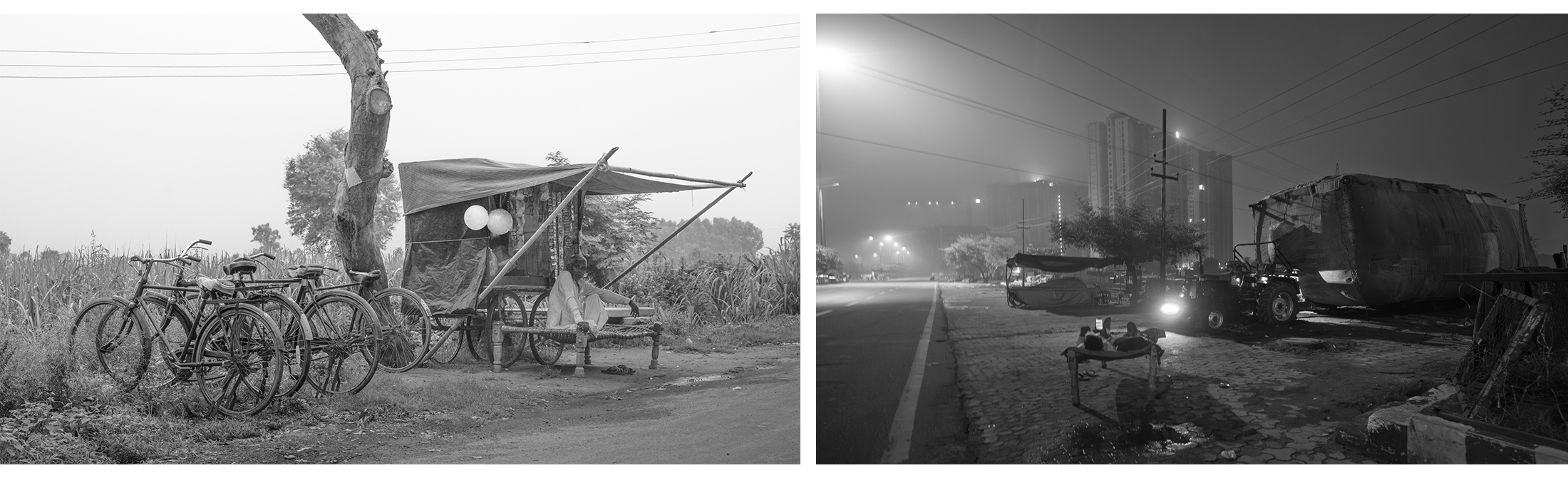
A man rests beside a roadside cigarette stall on the way to Kotdwar, my mothers hometown. A labourer scrolls his phone in front of a high-rise after dark. Two third spaces in two vastly different areas in the same state.
World's Highest LPG Bottling Plant, Phey Village, Leh District. Ladakh.
Indian Oil Corporation's Indane bottling plant, Phey village, Leh district, sits at 11,800 feet. It supplies LPG to the Indian Army and remote civilian areas. In 2019, New Delhi downgraded Ladakh to a Union Territory under direct central rule.
Bristol Tapestry, Composite with Storm Petrel and Museum Entry Column Statues. Gateway of Empire.
Sections of the Bristol Tapestry, 1976, reassembled as a composite with the text "Gateway of Empire" and the city's name, from Brixtoww to Bristol,taken from the tapestry. A taxidermied storm petrel and the museum's entrance statues frame the edges.
लेहरों में لکھی पहचान (An Identity Written in the Waves)
This zine is an exploration of Hindu-Muslim cultural entanglement and identity.
By layering portraits with reworked Mughal and Indian art, maps of lineage, and fragments
of language, the work resists nationalist binaries and exists beyond the trauma of the partition.